
In labs testing how brain implants could help people with physical disabilities, tales of success can be bittersweet.
Experiments like those that let a paralyzed person swig coffee using a robotic arm, or that let blind people “see” spots of light, have proven the huge potential of computers that interface with the brain. But the implanted electrodes used in such trials eventually become useless, as scar tissue forms that degrades their electrical connection to brain cells (see “The Thought Experiment”).
Next month, tests will begin in monkeys of a new implant for piping data into the brain that is designed to avoid that problem. The project is intended to lead to devices that can restore vision to blind people long-term.
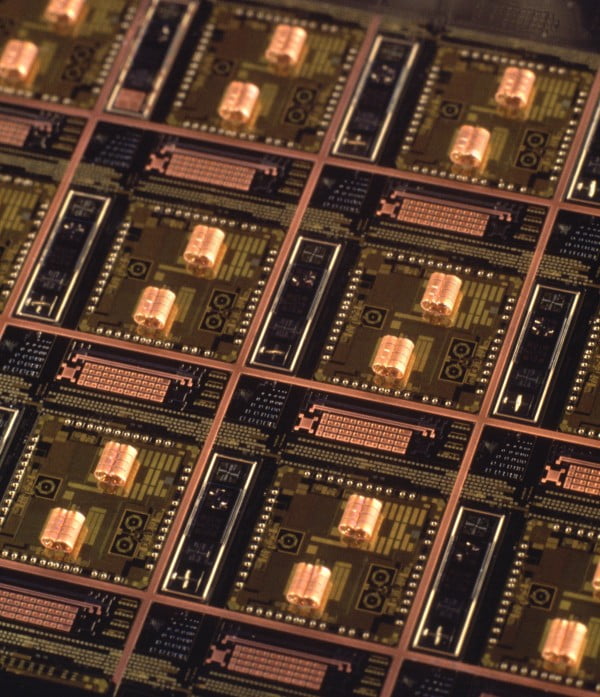
Researchers at Harvard Medical School will use a new kind of implant that will go beneath the skull but can rest on the surface of an animal’s brain, instead of penetrating inside the organ. An array of microscopic coils inside the hair-like device can generate powerful, highly targeted magnetic fields to induce electrical activity at particular locations in the brain tissue underneath. The implant will also be tested when placed inside brain tissue.
The device will be used to stimulate the visual cortex of the monkeys to try and re-create the activity normally triggered by signals from the eyes—creating the sensation of sight without the eyes’ input. Ultimately, the goal is to use the implant to convert signals from a camera into brain activity. Unlike conventional electrodes, the coils’ effectiveness shouldn’t degrade over time. Magnetic fields aren’t impeded by tissue forming around an implant as electric currents are.
The three-year project is supported by a multi-million dollar grant under the BRAIN initiative, created by President Obama to improve scientists’ understanding of how the brain works. “At the end of that we hope to have monkeys be able to navigate a maze, just by perceiving light and dark or basic geometric patterns,” says Bernard Casse, a researcher at the PARC research institute, owned by Xerox, where the new implant design was invented.
PARC’s design is already being tested in mice by researchers at Massachusetts General Hospital. Last December they published results showing that the tiny coils could trigger whisker movements in the animals by stimulating neurons inside their brains. The University of Florida is also collaborating on the project, and will study long-term stability of the implants in rats.
Todd Coleman, an associate professor at the University of California, San Diego, says that the new approach is promising, although it will be some time before it becomes clear how exactly it could be used in humans. If the technology proves useful, its use cases don’t have to be limited to the brain, he says.
“There could be very nice applications in other parts of the body,” says Coleman. He suggests the tiny coils could be used to modulate activity in the system of more than 100 million neurons associated with the human digestive system, for example, to help people with conditions in which the gut doesn’t move food along as it should. Casse says he is interested in exploring use of the technology on the vagus nerve in the chest to control symptoms of PTSD.
[Source:-MIT technology]