Are colleges engines of upward mobility? The preeminent expert on upward mobility, economist Raj Chetty of Stanford University, has a new paper out that seeks to answer that question. Along with coauthors John Friedman, Emmanuel Saez, Nicholas Turner, and Danny Yagan, Chetty created a one-of-a-kind dataset to track college attendees’ fortunes after they leave school—and compare those outcomes to the students’ economic backgrounds before entering college.
Encouragingly, the authors find that after attending the same college, students from poor and rich backgrounds see their adulthood incomes nearly equalized: the dream scenario for equality-of-opportunity enthusiasts. However, this finding does not necessarily mean that simply sending everyone to college will generate a fully egalitarian society.
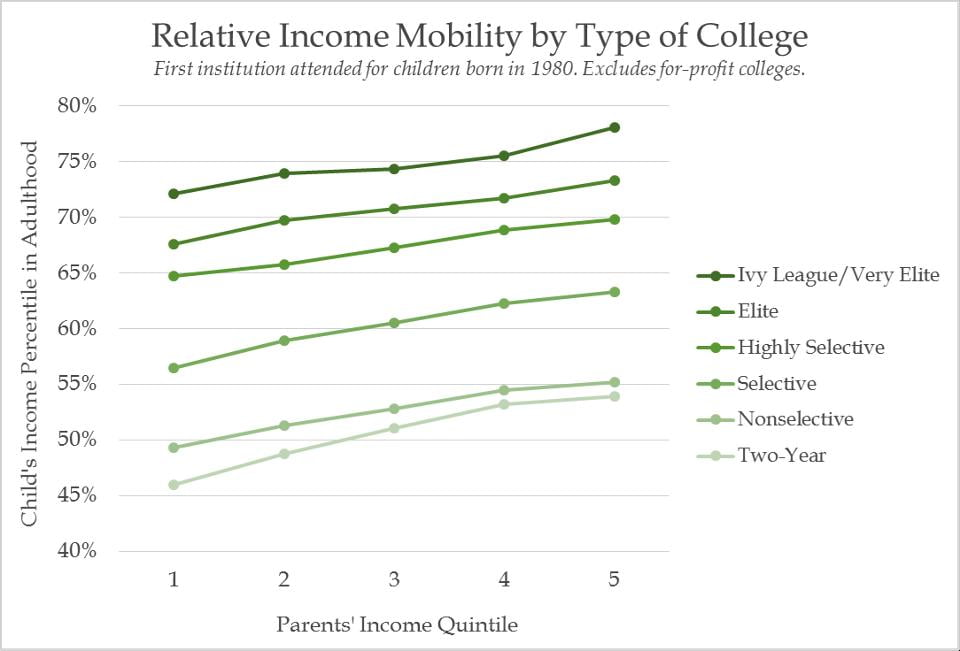
Helpfully, the Chetty team has made its underlying data available to the public. The graph below shows how students from different economic backgrounds fare in each “tier” of colleges. Flatter lines mean that students who attend the same type of college can expect similar incomes in adulthood regardless of their background as a child; steeper lines mean that a parent’s income has influence over his child’s fortunes in adulthood even though the child has received a college education.

Source: Author’s calculations based on Equality of Opportunity Project data.
For the most part, the lines are relatively flat. A child born into the bottom income quintile who attends an Ivy League or similarly elite college can expect to be in, on average, the seventy-second income percentile as an adult. In other words, a child whose parents were poorer than four-fifths of their fellow Americans can expect to be richer than nearly three-quarters of the population in adulthood—quite the turnaround. What’s even more striking is that a child born into the top quintile who attends the same college only fares slightly better than his low-income peer.
At these very elite colleges, students who were affluent as children will be only six percentiles higher in the income distribution than students who were poor. Similarly small earnings gaps exist for rich and poor students who attend colleges within less elite “tiers.” But among the American population as a whole, the relative earnings gap is over four times larger. Therefore, conditional on attending a certain type of college, most of the “opportunity gap” between rich and poor children disappears.
This works both ways—while poor students who attend Ivy League colleges do almost as well as their rich peers, students from wealthy backgrounds who attend nonselective colleges fare only a little better than their poor classmates. A top-quintile student who attends a nonselective college has downward mobility: on average, he will end up in the middle quintile as an adult.
The reason America still has such a large “opportunity gap” is because students from different economic backgrounds attend different colleges. True, poor students who go to Ivy League schools fare extremely well—but they make up a very small fraction of the student body there. As Chetty and his coauthors note, children with parents in the top 1% attend Ivy League colleges at 77 times the rate of children with parents in the bottom quintile.
[Source:-Forbes]