One of the best places to witness the the breakdown of social norms is an airport boarding line, where all sorts of misbehavior can be observed, even with an on-time flight (toss in delays and the pitchforks come out). There’s the sidlers, who stand nonchalantly on the side of the line waiting for the moment to innocently merge/cut in. There’s the brazen zone jumpers, who feign ignorance of the repeated announcements to only board in your zone. The milestones (people who stand leadenly impeding the efforts of people behind them to line up), the last minute luggage adjusters trying to stuff the contents of three bags into one oversized carryon, the belligerent arguers — gentle readers, I have seen them all through the course of my travels. And like you, I’m sure, I’ve asked myself, “surely there must be a better way?”
Airline operatives have also been puzzling over this question.
United Airlines recently added two color codes to its five numbered boarding areas, grouping travelers into blue or green depending on frequent flyer status. Maria Walter, the airline’s managing director of customer insights and innovation told The Washington Post that the new measures have improved boarding time and customer satisfaction metrics.
In a panel discussion at this year’s Code Conference, Delta Air Lines CEO Ed Bastian talked about the vexing issue of boarding and changes we may see in the future. “You see people looking to line up and everyone wants to get on at the same time, and most of them have their belongings. Why does anyone want to sit in an airline seat longer than they have to?” Bastian told moderators Kara Swisher and Jason Del Rey from Recode.
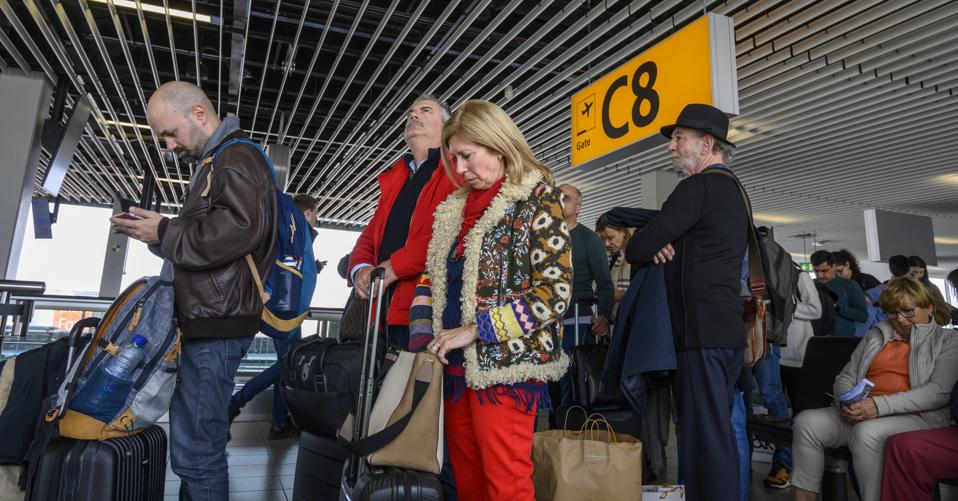
AMSTERDAM, THE NETHERLANDS – APRIL 14: Passengers queue to board TAP Airbus A319 to Lisbon, Portugal, at Departures area C of Schiphol International Airport on April 14, 2019 in Amsterdam, The Netherlands. Amsterdam Airport Schiphol is the main
CORBIS VIA GETTY IMAGES
With RFID technology becoming more prevalent in airports around the world, flyers may be more willing to be parted with their bags — a crucial point in overcrowded planes due to checked baggage fees. Delta rolled out RFID in 2016, and British Airways just announced that it is launching TAG, a reusable digital bag tag allowing customers to track their luggage throughout the flight. A year ago, the International Air Transport Association voted to develop an RFID standard, and earlier this month, voted to require airlines and airports to use RFID worldwide on luggage, according to RFID Journal.
Delta has been looking at redesigning the boarding process itself, said Bastian, removing the podiums and presumably the lines as well. Passengers would sit in designated chairs and agents would “serve as a host or hostess rather than a ticket-taker…Transaction, that’s how you build relationships,” said Bastian.
Key to this plan is changing those preboarding patterns engrained in people through years of (often bad) habits. “It’s going to take time, we are experimenting with it. But it’s knowing that the agents are out there with a technology in their hand, and that’s who you need to talk to,” said Bastian.” And these people will be trained to try to scoop up bags if there’s bags that can be checked, but again, it’s going to take some time. There has to be confidence that the technology works and it’s being delivered on.”
In addition to these measures, the move to paperless travel may help speed up boarding by streamlining passenger time in retrieving printed boarding passes or documentation. A World Economic Forum initiative announced in June allows travelers to leave the passport at home when flying between Canada and the Netherlands. The Known Traveller Digital Identity program will store passport information on a mobile phone rather than the chip on a printed passport. “By 2030, international air arrivals are expected to reach 1.8 billion passengers, up 50% from 2016. Under today’s systems, airports cannot keep up with this growth,” says Christoph Wolff, Head of Mobility at the World Economic Forum said in a release. “This project offers a solution. By using an interoperable digital identity and other KTDI technologies we are offering travellers a holistic answer to secure and seamless travel. This will shape the future of aviation and security.”
Biometric use in airports has been somewhat controversial thus far. “It’s another step toward creating a comprehensive tracking system,” said Jay Stanley, a policy analyst with the American Civil Liberties Union told NBC News. “That’s our ultimate fear, that we turn into a society where we are tracked in that way.” According to The World Economic Forum, there are measures in place to limit storage of this data. “Individual consent is needed each time data is sent, which gives travellers more control over their personal data than the existing passport system,” read the release.
As technology evolves to change the airports of the future, more and more of the process will become automated. Whether this evolution will change the mind of the most determined boarding line jumper, however, is anyone’s guess.
[“source=forbes”]